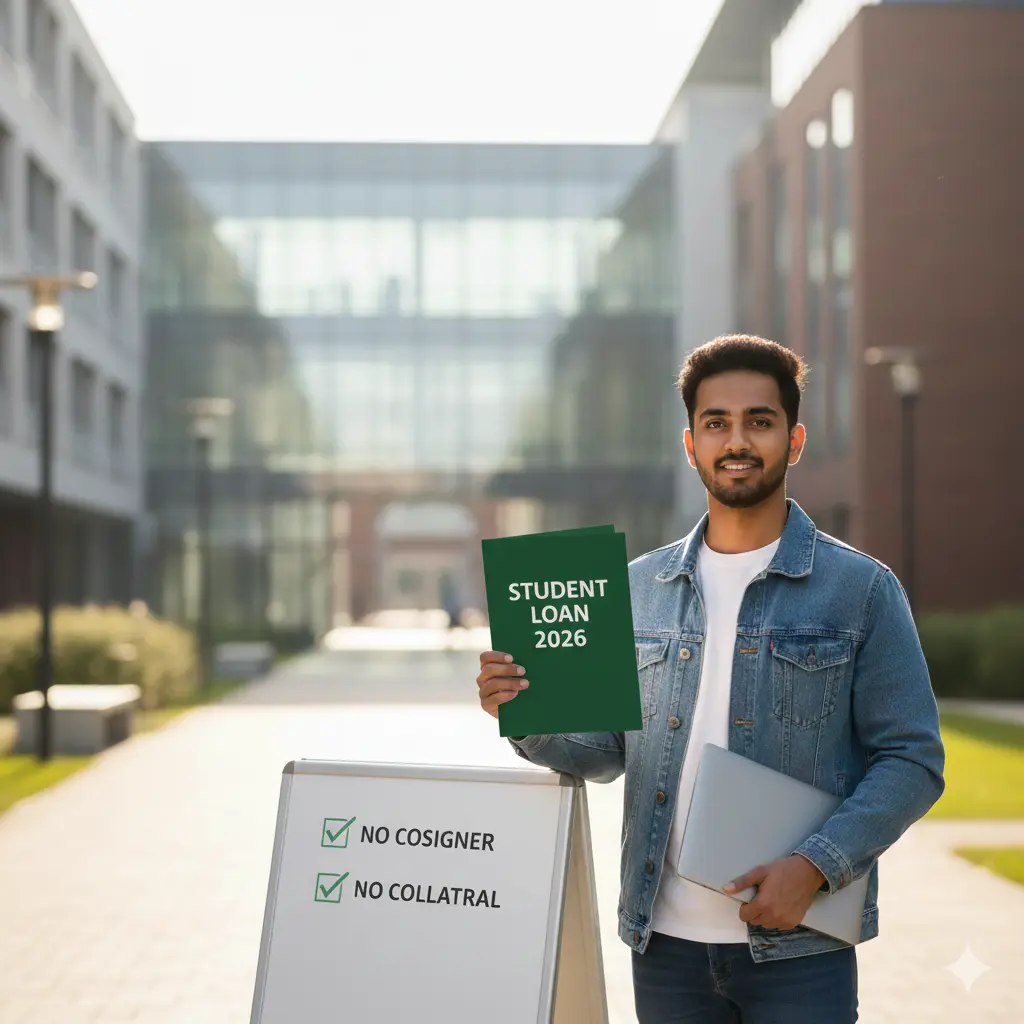
No Cosigner? No Collateral? No Problem: Your 2026 Guide to Student Loans for Indian Students
Reading time: 12-14 min
By BorderlessLoans Team
You’ve earned admission to a top U.S. university. Your test scores are strong. Your statement of purpose impressed the committee. But now comes the challenge that stops thousands of Indian students every year: funding. Traditional banks want a U.S. cosigner you don’t have—or property collateral your family can’t risk.
Here’s the reality: 363,019 Indian students studied in the United States during 2024/25, making India the number one source country for international students. Many of these students faced the exact same funding barrier you’re facing right now. The difference? They discovered that modern lenders have fundamentally changed how international student loans work.
Traditional financing models were built for domestic students with established U.S. credit histories and family members who could cosign. But specialized lenders now evaluate what actually matters for international students: your future earning potential based on your school, program, and academic performance—not your family’s property or your non-existent U.S. credit score.
This comprehensive guide walks you through everything you need to know about securing education financing without a cosigner or collateral. You’ll learn how no-cosigner loans actually work, the step-by-step approval process, how to compare your funding options, and real success stories from Indian students who funded their U.S. education independently.
No-Cosigner Student Loans: Key Statistics 2025
- 363,019 Indian students studied in the U.S. during 2024/25, representing 10% year-over-year growth (Source: IIE Open Doors 2024)
- $13.9 billion borrowed from nonfederal (private) sources in 2024-25, proving private loans are mainstream funding solutions (Source: College Board 2025)
- 60% of graduate degree holders took on debt to finance their education—borrowing is the norm, not the exception (Source: BestColleges 2025)
- $50,920 average annual budget for out-of-state students at public 4-year universities in 2025-26 (Source: College Board 2025)
Check Your Eligibility in Minutes
MPOWER offers loans up to $100,000 for Indian students. No U.S. cosigner required. No collateral needed. Students from 200+ countries qualify.
Why No-Cosigner Loans Make Sense for Indian Students
You Don’t Have a U.S. Cosigner (And That’s Normal)
Traditional student loans require a U.S. citizen or permanent resident with strong credit to cosign your loan. For international students, this creates an impossible barrier. You’re new to the country. You don’t have relatives with U.S. citizenship. Even finding a willing cosigner means putting someone else’s credit and financial security at risk for your education.
No-cosigner loans eliminate this requirement entirely. Lenders evaluate you based on your school’s reputation, your program’s outcomes, and your academic performance—factors that actually predict your ability to repay after graduation.
Your Family Doesn’t Need to Risk Property or Assets
Indian banks typically require property collateral for education loans above ₹7.5 lakhs (approximately $9,000 USD). For a U.S. Master’s degree costing $60,000-$80,000, this means putting your family home or other significant assets at risk. If economic circumstances change or repayment becomes challenging, your family’s financial security is threatened.
No-cosigner loans are unsecured, meaning no property or assets are required as collateral. The lender’s risk is based on statistical analysis of graduate outcomes, not your family’s property. Your education funding doesn’t put your family’s home in jeopardy.
Faster Approval Process
Traditional bank loans in India can take 4-8 weeks for approval, requiring extensive documentation, property valuation, and multiple in-person meetings. No-cosigner lenders operate digitally with streamlined processes. Many students receive approval decisions within 3-5 business days of submitting complete applications.
This speed matters when you’re racing against university deposit deadlines or need loan approval documentation for your F-1 visa interview. Fast approval also reduces stress during an already intense period of transition planning.
USD-Denominated Protection Against Currency Fluctuation
If you borrow from an Indian bank in rupees but study and potentially work in the U.S., you face currency exchange risk. A 10% rupee depreciation against the dollar effectively increases your loan burden by 10%. Between 2014 and 2024, the rupee depreciated from approximately ₹60 to ₹83 per dollar—a 38% decline.
No-cosigner loans from U.S. lenders are denominated in USD. Your education costs are in dollars, your OPT salary is in dollars, and your loan is in dollars. This alignment eliminates currency risk and makes repayment planning straightforward.
Built for International Student Success
Specialized no-cosigner lenders understand international student challenges. They offer support services designed specifically for your situation: career development programs, resume review, interview preparation, and job search guidance. Some lenders like MPOWER provide Path2Success™ career services at no additional cost.
These services directly impact your ability to secure employment and repay your loan successfully. Traditional banks provide money but no support infrastructure for your transition to the U.S. job market.
Strong Graduate Outcomes Justify the Model
No-cosigner lenders can offer these loans because data proves international graduate success. According to the Bureau of Labor Statistics, the unemployment rate for workers with Master’s degrees was just 2.2% in 2024—significantly lower than the 3.9% national average. Computer and information technology occupations, popular among Indian international students, are projected to grow 13% from 2023 to 2033, adding 377,500 new jobs annually.
These strong employment outcomes mean lenders can confidently extend unsecured credit to qualified international students at top universities. Your future earning potential is the collateral.
How to Get Approved: The Step-by-Step Process
Step 1: Verify Your School Eligibility
Why It Matters: Not all universities are covered by no-cosigner lenders. Lenders maintain approved school lists based on historical graduate outcomes and institutional reputation. Attending a supported school is the foundational eligibility requirement.
How to Execute:
- Visit MPOWER’s school eligibility page: mpowerfinancing.com/schools
- Search for your admitted university and program
- Verify both undergraduate and graduate programs if applicable
- Check minimum enrollment requirements (typically half-time or full-time)
What to Know: MPOWER supports 195+ top universities in the U.S. and Canada. If your school isn’t listed, contact them—they regularly add institutions based on student demand.
Step 2: Gather Required Documentation
Why It Matters: Complete applications process faster and have higher approval rates. Missing documentation causes delays and can result in missed university deposit deadlines.
Essential Documents:
- Admission Letter or I-20: Official document from your university confirming enrollment
- Valid Passport: Current passport with at least 6 months validity
- Academic Transcripts: Official records from your undergraduate institution
- Test Scores: GRE, GMAT, TOEFL, or IELTS scores as applicable
- Visa Documents: F-1 visa approval if available (not required to start application)
- Financial Documents: Bank statements showing available funds
Pro Tip: Organize digital copies in PDF format before starting your application. Clear, readable scans prevent requests for document resubmission.
Step 3: Start Your Application Online
Why It Matters: Digital applications process in 3-5 business days versus 4-8 weeks for traditional bank loans. Starting early gives you loan approval documentation for visa interviews and ensures funds arrive before tuition deadlines.
Application Steps:
- Create account on lender’s website (takes 5-10 minutes)
- Complete basic information: personal details, school, program, degree level
- Upload required documents directly through secure portal
- Submit application for review
Timeline: Most students complete the initial application in 20-30 minutes. Document upload adds another 15-20 minutes. Total initial time investment: under one hour.
Step 4: Undergo Credit Assessment
Why It Matters: While you don’t need U.S. credit history, lenders use alternative assessment methods to evaluate your repayment likelihood. Understanding what they analyze helps you strengthen your application.
Evaluation Factors:
- School Quality: University reputation and ranking influence approval
- Program Outcomes: Employment rates and average salaries for your program
- Academic Performance: GPA, test scores, academic honors
- Degree Relevance: STEM programs often have higher approval rates due to strong job market
- Financial Capacity: Evidence of savings or other funding sources
What Happens: Lender’s underwriting team reviews your complete profile. They may request clarification or additional documentation. Typical review time: 3-5 business days.
Step 5: Review and Accept Your Loan Offer
Why It Matters: Understanding your loan terms before acceptance prevents surprises during repayment. This is a multi-year financial commitment—take time to fully understand what you’re agreeing to.
Key Terms to Review:
- Loan Amount: Total approved funding (may be less than requested)
- Interest Rate: Fixed or variable, annual percentage rate
- Repayment Term: Typical terms range from 7-20 years
- Grace Period: Time before repayment begins (often 6 months post-graduation)
- Monthly Payment: Estimated payment amount during repayment
- Total Cost: Principal plus interest over life of loan
Questions to Ask: Can I make prepayments without penalty? What happens if I defer enrollment? What career support services are included?
Step 6: Complete Final Verification
Why It Matters: Final verification confirms your enrollment and ensures funds are disbursed to the correct university account. This step prevents fraud and protects both you and the lender.
Verification Requirements:
- Signed loan agreement and promissory note
- Confirmed enrollment status at university
- University’s bursar contact information for direct disbursement
- Verification of current student status each term
Timeline: Final verification typically takes 5-10 business days. Plan for a total process of 3-4 weeks from application to fund disbursement.
Step 7: Receive Funds and Begin Your Program
Why It Matters: Understanding how disbursement works ensures your tuition is paid on time and you have access to funds for living expenses.
Disbursement Process:
- Direct to School: Lender sends tuition directly to university bursar
- Living Expenses: Remaining funds (after tuition) disbursed to your account
- Per-Term Funding: Loans typically disburse once per semester/term
- Enrollment Verification: Must confirm enrollment each term to receive subsequent disbursements
Important: Maintain at least half-time enrollment to remain eligible for continued loan disbursements throughout your program.
Understanding Costs and Funding Options
Complete Cost Breakdown for U.S. Master’s Programs
Annual Costs (2025-26 Academic Year):
- Tuition: $30,000-$55,000 USD (approximately ₹25,05,000-₹45,92,500 INR) depending on public vs. private university
- Housing: $12,000-$18,000 USD (approximately ₹10,02,000-₹15,03,000 INR) for on-campus or shared apartments
- Meals: $4,000-$6,000 USD (approximately ₹3,34,000-₹5,01,000 INR) for groceries and occasional dining
- Books/Supplies: $1,200-$2,000 USD (approximately ₹1,00,200-₹1,67,000 INR)
- Health Insurance: $2,000-$3,500 USD (approximately ₹1,67,000-₹2,92,250 INR) mandatory for F-1 students
- Transportation: $1,500-$2,500 USD (approximately ₹1,25,250-₹2,08,750 INR) local transit and occasional travel
- Personal Expenses: $2,000-$3,000 USD (approximately ₹1,67,000-₹2,50,500 INR) including phone, clothing, miscellaneous
Total Annual Budget: $52,700-$90,000 USD (approximately ₹44,00,250-₹75,15,000 INR)
Two-Year Master’s Total: $105,400-$180,000 USD (approximately ₹88,00,500-₹1,50,30,000 INR)
Note: Currency conversion uses approximate rate of ₹83.50 per USD as of December 2025. Actual costs vary by university location and lifestyle choices.
Comparing Funding Options
| Funding Source | Requirements | Typical Amount | Best For |
|---|---|---|---|
| Traditional U.S. Banks | U.S. cosigner with good credit required | Up to full cost of attendance | Students with U.S. relatives |
| Indian Bank Loans | Property collateral for amounts >₹7.5L | Up to ₹1.5 crore | Families with property assets |
| MPOWER Financing | No cosigner, no collateral needed | $2,001-$100,000 | Independent international students |
| Merit Scholarships | Strong academics, competitive application | $5,000-$30,000 per year | Top students, reduce total debt |
| Personal Savings | None – your own funds | Varies widely | Partial funding, debt reduction |
Real Scholarship Opportunities for Indian Students
Verified Scholarship Programs:
- Fulbright-Nehru Master’s Fellowships: Fully funded Master’s programs in all fields at U.S. universities. Application deadline: March/April annually. (USIEF Official)
- Inlaks Scholarships: Up to $100,000 for Master’s/PhD programs at top universities. Limited to exceptional Indian students. (Inlaks Foundation)
- Tata Scholarship (Cornell): Need-based funding specifically for Indian undergraduates at Cornell University. (Cornell Financial Aid)
- Stanford Reliance Dhirubhai Fellowship: Full funding for MBA students from India at Stanford GSB. Highly competitive. (Stanford GSB)
- University-Specific Merit Awards: Most U.S. universities offer partial tuition scholarships to admitted students with strong profiles. Check each school’s graduate program website for details.
Application Strategy: Apply to scholarships as early as possible. Even partial scholarships ($10,000-$20,000) significantly reduce your loan burden and strengthen your visa application by demonstrating additional funding sources.
MPOWER Financing: Complete Details
What MPOWER Offers:
- Loan Amounts: $2,001 to $100,000 total across your degree program
- No Cosigner Required: Apply independently without a U.S. cosigner
- No Collateral Needed: Unsecured loans based on future earning potential
- 195+ Supported Schools: Major U.S. and Canadian universities
- Fixed Interest Rates: Rates remain constant throughout repayment
- Autopay Discount: 0.25% rate reduction when you enroll in automatic payments
- Flexible Repayment: Terms from 7-20 years based on your needs
- Grace Period: No payments required while enrolled; 6-month grace period after graduation
- Path2Success™ Career Support: Resume reviews, mock interviews, job search guidance, networking opportunities at no extra cost
Who Qualifies: Students from 200+ countries attending supported universities. Strong academic record required. Both undergraduate and graduate students eligible. STEM programs have particularly strong approval rates due to excellent employment outcomes.
Strategic Borrowing: How Much Do You Actually Need?
Calculate Your Real Funding Gap:
- Start with Total Costs: Use your university’s official Cost of Attendance (COA) from your I-20
- Subtract Existing Resources:
- Personal/family savings available for education
- Scholarships or assistantships awarded
- Expected income from on-campus work ($10,000-$15,000 over two years)
- Remaining Amount = Loan Requirement: Borrow only what you truly need
Smart Borrowing Principles:
- Minimize First-Year Borrowing: Use savings first; loans for second year
- Account for Part-Time Work: On-campus jobs ($15-$20/hour) can contribute $8,000-$12,000 annually
- Plan for Summer Income: Many Master’s students work summer internships earning $15,000-$25,000
- Consider Parent Contribution: Even $10,000-$15,000 family support significantly reduces debt
Example: If total costs are $120,000 for two years, you have $20,000 in savings, expect $20,000 from part-time work, and family contributes $15,000, your actual loan need is $65,000—not the full $120,000.
Ready to Fund Your Education?
MPOWER has supported students from 200+ countries. No cosigner. No collateral. Fast approval. Start your application today.
Why MPOWER’s Model Works for International Students
Founded by International Students, For International Students
MPOWER Financing was founded by Manu Smadja and Michael Davis, both international students who personally experienced the funding challenges you’re facing. They couldn’t find lenders willing to work with international students without cosigners or collateral. So they built the company they wished had existed when they were students.
This origin story matters because it means MPOWER’s entire business model is designed around your specific situation. They don’t offer international student loans as a side product—it’s their core mission. Every policy, every support service, every decision is made with international student success in mind.
Data-Driven Underwriting Replaces Traditional Credit Checks
Traditional lenders use FICO scores and U.S. credit history to predict repayment likelihood. This system excludes international students by design. MPOWER built alternative assessment models that evaluate factors actually predictive for international graduates:
- University Quality: Graduation rates, employer reputation, alumni outcomes
- Program Strength: Employment rates and starting salaries by major
- Academic Performance: GPA, test scores, coursework rigor
- Career Trajectory: Internships, relevant experience, professional goals
- Financial Planning: Savings, budget understanding, funding strategy
These factors better predict your ability to secure good employment and repay loans than whether you had a U.S. credit card. The model works: MPOWER has successfully funded thousands of international students who went on to successful careers.
Path2Success™: Career Support That Improves Outcomes
MPOWER doesn’t just provide capital—they actively support your career success, which directly benefits both you and them. Path2Success™ career services include:
- Professional Resume Review: Experts optimize your resume for U.S. employer expectations
- Mock Interview Practice: Practice common interview questions and receive feedback
- Job Search Guidance: Strategies for finding positions, networking, application optimization
- Alumni Network: Connect with previous borrowers in your field and location
- Employer Partnerships: Access to companies actively hiring international graduates
These services are included at no additional cost because your employment success ensures loan repayment. It’s an aligned incentive structure—they want you to land a great job as much as you do.
Flexible Repayment Designed for Your Career Timeline
MPOWER understands that international student careers don’t follow a single path. Their repayment options accommodate different scenarios:
- In-School Deferment: No payments required while enrolled at least half-time
- Grace Period: 6 months after graduation before repayment begins
- Interest-Only Option: Make small interest payments during school to reduce total cost
- Standard Repayment: Fixed monthly payments over 7-20 year terms
- Prepayment Welcome: No penalties for paying off loans early
Many STEM graduates with OPT work authorization aggressively pay down loans during their 36-month post-graduation work period. With average starting salaries of $101,650, this strategy allows complete loan payoff in 2-4 years.
Transparent Terms: No Hidden Fees or Surprises
Some international student lenders bury costs in complex fee structures. MPOWER maintains transparent, straightforward pricing:
- Fixed Interest Rate: Your rate never increases over the loan term
- No Prepayment Penalties: Pay off early and save on interest
- No Hidden Fees: All costs disclosed upfront in your loan agreement
- 0.25% Autopay Discount: Automatic payments reduce your rate
- Clear Repayment Terms: Know exactly what you’ll pay each month
Before accepting any loan—from MPOWER or elsewhere—read the complete loan agreement. Understand the total cost of the loan including all interest payments. Compare annual percentage rates (APR) across lenders, not just monthly payments.
Special Considerations for Indian Students
Using Loan Approval for F-1 Visa Interviews
Your loan approval letter serves as proof of financial support during your F-1 visa interview. Visa officers need evidence you can afford your education without unauthorized employment. A formal loan approval from MPOWER or similar lender demonstrates:
- You have secured funding for the full cost of your program
- The funding source is legitimate and verifiable
- You have a clear plan for covering all expenses
- You won’t need to work illegally to support yourself
Best Practice: Apply for your loan as soon as you receive your I-20. Bring your loan approval letter, university I-20, and any other financial documents (bank statements, scholarship letters) to your visa interview. Having multiple funding sources documented increases visa approval confidence.
Managing Currency Exchange Risk
USD-denominated loans eliminate currency risk during your U.S. study and work period. However, if you return to India after graduation, you’ll repay your USD loan from INR income. Consider these strategies:
- Maximize U.S. Repayment: Pay down as much as possible during OPT when earning USD
- Build USD Savings: Maintain a USD account to buffer against exchange rate fluctuations
- Seek Global Companies: Work for companies that pay competitive USD-equivalent salaries in India
- Accelerate Payments: Making extra payments reduces principal and total interest cost
Historical context: From 2014-2024, INR depreciated from ₹60 to ₹83.50 per USD. A $50,000 USD loan would have cost ₹30 lakhs in 2014 but ₹41.75 lakhs in 2024—a 39% increase in rupee terms despite unchanged dollar amount.
Tax Implications in India and the U.S.
U.S. Tax Considerations:
- Student loan interest may be tax-deductible up to $2,500 annually if you’re required to file U.S. taxes
- Consult a tax professional familiar with international student tax requirements
- Keep detailed records of all loan payments for potential deductions
India Tax Considerations:
- Education loans from Indian lenders may offer tax benefits under Section 80E
- Foreign currency loans may have different tax treatment—consult an Indian CA
- If you return to India, understand tax obligations on foreign loan payments
Important: Tax rules are complex and change frequently. This is not tax advice. Always consult qualified tax professionals in both countries.
Building U.S. Credit History
Successfully repaying your student loan helps establish U.S. credit history, which matters for:
- Future Loans: Car loans, mortgages if you stay in the U.S.
- Credit Cards: Easier approval for cards with better rewards
- Apartment Rentals: Better chances of approval without large deposits
- Employment: Some employers check credit as part of background checks
Credit Building Strategy:
- Make every loan payment on time—payment history is 35% of your credit score
- Set up automatic payments to never miss a due date
- Get a secured credit card during your first semester to start building credit early
- Keep credit utilization low (under 30% of available credit)
- Monitor your credit score regularly through free services
A strong U.S. credit score (700+) dramatically improves your financial options if you pursue long-term U.S. residence.
What If You Can’t Complete Your Program?
Life circumstances change. Understand your options if you can’t complete your degree:
- Leave of Absence: Most lenders allow temporary leave if you plan to return
- Hardship Programs: Temporary payment reduction or deferment during difficulties
- Withdrawal: If you withdraw, repayment typically begins within 6 months
- Transfer Schools: Some lenders allow transfers to other eligible institutions
Important: Communicate immediately with your lender if circumstances change. Most have support programs to help borrowers through difficult periods. Ignoring the problem makes it worse—lenders are more willing to work with borrowers who communicate proactively.
Success Stories: Indian Students Who Made It Work
Santoshi’s Story: From Loan to Financial Independence
Challenge: Santoshi needed funding for her Canadian Master’s program but didn’t want to risk her family’s property with traditional bank collateral requirements.
Solution: She secured a no-cosigner loan through MPOWER, covering her tuition and living expenses without putting family assets at risk.
Outcome: After graduating, Santoshi landed 6 job offers in Canada. She paid off her entire student loan early and achieved complete financial independence—all within a few years of graduation. Her success enabled her to support her family back in India while building wealth in Canada.
Source: MPOWER Financing Success Story
Ajay’s Journey: Scholarship Plus Loan Strategy
Challenge: Ajay earned a full scholarship to Georgetown University for tuition, but the scholarship didn’t cover living expenses in expensive Washington, D.C. Without funding for housing, meals, and other costs, he couldn’t accept his scholarship offer.
Solution: MPOWER provided a loan covering his non-tuition expenses. This combination of scholarship plus targeted loan made his Georgetown education financially feasible.
Outcome: The loan enabled Ajay to accept his full scholarship and pursue his Master’s degree at one of America’s top universities. His Georgetown degree opened doors to career opportunities that justified the modest loan for living expenses.
Source: MPOWER Financing Success Story
Neha Purohit: MBA to Principal Product Manager
Challenge: Neha wanted to pursue an MBA but needed rapid loan disbursement to meet university deposit deadlines. Traditional banks’ slow approval processes risked losing her spot.
Solution: She applied to MPOWER and received a no-cosigner loan approval within days. The fast processing ensured she could secure her MBA program spot without delay.
Outcome: Her MBA investment paid off dramatically. Neha is now a Principal Product Manager, earning significantly more than she would have without the degree. The rapid loan approval enabled her entire career transformation.
Source: MPOWER Financing Success Story
Common Success Pattern: These students all secured no-cosigner loans, completed strong academic programs, landed employment in their fields, and are successfully repaying their loans while building careers and wealth. Their success demonstrates that the no-cosigner model works when students attend quality universities, work hard academically, and leverage career support resources.
Your Success Story Starts Here
Thousands of international students have funded their education through MPOWER. No cosigner, no collateral, no barriers. Check your eligibility in minutes.
Frequently Asked Questions
What credit score do I need if I have no U.S. credit history?
No-cosigner lenders don’t require U.S. credit scores because they understand international students don’t have them. Instead, they use alternative credit assessment evaluating your school’s reputation, program outcomes, and academic performance. Strong students at respected universities have excellent approval chances even with zero U.S. credit history.
How much can I borrow without a cosigner?
MPOWER offers loans from $2,001 to $100,000 total for your degree without a cosigner. The exact amount you’re approved for depends on your school, program, cost of attendance, and individual profile. For most two-year Master’s programs, students can secure sufficient funding to cover tuition and living expenses.
What are the current interest rates for no-cosigner student loans?
Interest rates vary by lender and individual profile. For reference, federal graduate student loans in the U.S. carry a 7.94% fixed rate for 2025. Private lenders’ rates depend on your school, program, and creditworthiness assessment. MPOWER offers fixed rates with a 0.25% discount for autopay enrollment. Always compare multiple offers before accepting.
Is the interest rate fixed or variable?
MPOWER offers fixed interest rates, meaning your rate stays the same for the entire loan term. This protects you from market fluctuations and makes budgeting predictable. Some lenders offer variable rates that may start lower but can increase over time. For most students, fixed rates provide better long-term security.
What documents do I need to apply?
Typical requirements include your admission letter or I-20 from the university, valid passport, academic transcripts, standardized test scores (GRE/GMAT), and visa documents if available. You can often begin the application before receiving all documents, with final approval contingent on complete documentation. Check your specific lender’s requirements before starting.
How long does the approval process take?
Digital-first lenders like MPOWER typically provide decisions within a few business days of receiving complete applications. The entire process from application to disbursement usually takes 2-4 weeks. Apply early—ideally right after receiving your I-20—to ensure funds are available before tuition deadlines and to have approval documentation for your visa interview.
Can I apply before receiving my I-20?
Many lenders allow you to start the application process before your I-20 arrives. You can provide preliminary information and documents, with final approval pending your official enrollment confirmation. This gives you a head start and provides an estimated loan offer to factor into your decision-making between schools.
When do I start repaying my loan?
Most student loans offer grace periods that delay full repayment until after graduation. Typically, repayment begins 6 months after you graduate, leave school, or drop below half-time enrollment. During your study period, you may have options for interest-only payments or full deferment. Understand your specific loan terms before accepting.
Can I make payments while on OPT?
Yes, and doing so is recommended. OPT and STEM OPT provide up to 36 months of U.S. work authorization for eligible students. With STEM salaries averaging $101,650 annually, many graduates can make significant loan payments or pay off entirely during this period. Starting aggressive repayment early reduces total interest costs substantially.
What happens if I return to India after graduation?
Your loan obligation remains regardless of where you live. If you return to India, you’ll continue making payments in USD from your Indian income. Many graduates find that U.S. education credentials command premium salaries in India, making repayment manageable even without U.S. income. Plan for exchange rate fluctuations in your repayment budget.
How do no-cosigner loans compare to Indian bank education loans?
Indian bank loans (SBI, HDFC, etc.) typically require property collateral and may have lower interest rates but involve lengthy approval processes and put family assets at risk. No-cosigner international loans offer faster approval, no collateral requirement, and are designed specifically for U.S. study. Compare total costs, including processing time and risk factors, not just interest rates.
Should I use a cosigner if I have one available?
Having a U.S. cosigner may qualify you for lower interest rates with some lenders. However, cosigning creates serious financial obligations for that person—they’re fully responsible if you can’t pay. Consider whether the rate savings justify the relationship risk. Many students prefer the independence of no-cosigner loans even when cosigners are available.
Does MPOWER offer job search support?
Yes. MPOWER’s Path2Success™ program provides career development services at no extra cost to borrowers. Services include professional resume review, mock interview practice, job search strategy guidance, and networking opportunities with alumni and employers. This support directly helps you land employment and succeed in loan repayment.
About BorderlessLoans: We provide educational content to help international students navigate study abroad financing. Our articles are for informational purposes and do not constitute financial advice. Always consult with qualified financial advisors and thoroughly research any lender before borrowing. Loan terms, rates, and availability are subject to change.